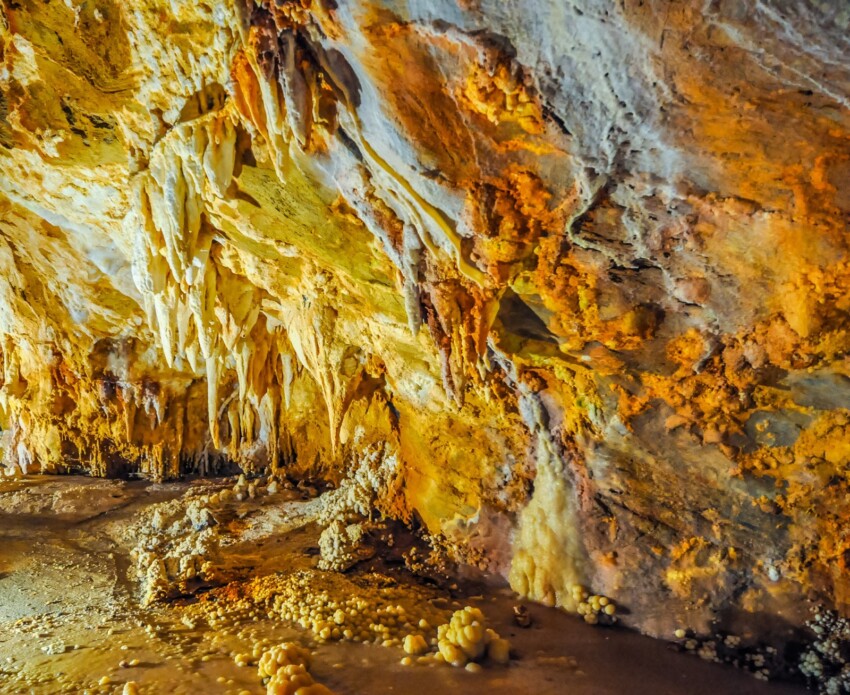
Just a short distance from crowded beaches and trails busy with hikers and mountain bikers, western Liguria’s landscape conceals a marvellous natural treasure: the Toirano Caves, less than a kilometre from the centre of a charming Roman-founded village near Loano.
The Toirano Caves are an attraction not to be missed for anyone on holiday in the province of Savona. Leaving the sunlight behind, you venture through tunnels, caverns and underground chambers in search of traces left by humans and animals who entered these caves over 10,000 years ago.
Combined with the exceptional beauty of this unique natural environment is extraordinary archaeological significance: an incredible number of human footprints and bones of prehistoric bears have been found within these caves. This immense heritage has made it possible to piece together a picture of who visited these caverns in ancient times.
Known for some time, the Toirano Caves were thoroughly explored in the twentieth century from the 1950s onwards and were almost immediately opened to visitors. Today, thanks to an easy, well-lit visitor route, you can admire the traces left by humans and animals of the past and striking rock formations covered with crystals and minerals.
The visit to the Toirano caves follows a tourist trail that leads into the two most famous caves of the complex: the Grotta della Basura and the Grotta di Santa Lucia Inferiore. These two are connected by an artificial tunnel carved into the rock at 150 metres below the surface; it was completed in 1967. During your visit you will also see a small underground lake.
The caves not open to visitors are the Grotta di Santa Lucia Superiore and the Grotta del Colombo; the latter yielded prehistoric remains dating back more than 300,000 years ago.
Also closed to the public is the Hall of Mysteries, a chamber in the Grotta della Basura that has provided invaluable information about the ancient inhabitants of these caves. Human footprints and clay pellets attached to the walls were found in this chamber: the most plausible theory is that the pellets were hurled at the walls during a ritual in the Upper Palaeolithic period.
The final section of the cave, known as the Tanone and devoid of formations, was accessible to the local population even before the caves were explored and equipped for visitors. During the Second World War it was used as an air-raid shelter, whilst today it is the evocative setting for concerts and cultural events.
The Grotta della Basura (or Witch’s Cave) was the first of the Toirano caves to be explored in depth. It was opened to the public as early as 1953, when the Lower Santa Lucia Cave had not yet been explored.
More than 14,000 years ago, the galleries that make up this cave were traversed by a small group of five people whose footprints have provided valuable information about their age, physical characteristics and movements. More mysterious is why these 2 adults and 3 children were inside the cave.
Your guide inside the caves will tell you all about the important discoveries made thanks to the traces they left in the rock. You will also be able to see the marks left by the hands, feet and knees of prehistoric humans in the so-called Corridor of Footprints.
In addition to human footprints, the Grotta della Basura also preserves a large quantity of bone remains of the cave bear (scientific name: Ursus spelaeus), a prehistoric animal that sheltered in caverns during winter hibernation.
Bear bones have been found throughout the cave, but about 400 metres from the entrance of the tourist route, the number of bones found is so high that the area has been named the Cemetery of the Bears.
It is estimated that the bones discovered belonged to more than 130 specimens, both cubs and adult bears, and that bears inhabited these caves over a period spanning 50,000 to 24,000 years ago.
The Cemetery of the Bears is undoubtedly one of the most moving moments of a visit to the Toirano caves.
After visiting the first cave, you pass through an underground tunnel to the Grotta di Santa Lucia Inferiore. In this second part of the visit you can admire bizarrely shaped aragonite formations covering the walls of the underground cavities.
From the Grotta di Santa Lucia Inferiore you then reach the exit without passing through the first cave again.
Entrance to the caves also includes a visit to the Etnografico Museum of Val Varatella, a small municipal museum that tells the story of traditions, trades and life in the village over the centuries.
Housed in a historic palazzo, it displays a collection of objects, mostly donated by local families, and period furniture.
After visiting the caves, take a stroll through the village of Toirano. It’s a charming little town of cottages and churches nestled in greenery, awarded the Orange Flag by the Italian Touring Club for its well-maintained historic centre with numerous characteristic corners, remains of walls and medieval towers.
The three-arched bridge over the Varatella stream is particularly lovely.
The Toirano caves can be visited year-round with guided tours in the morning or afternoon; opening times may vary depending on the season. The caves remain closed to the public if weather conditions or other circumstances could affect the safety of the route.
This is a much-visited attraction: if you want to avoid queues at the ticket office or don’t like very large groups, try to arrive early in the morning.
The ticket includes entry to the two caves connected by the tunnel (Basura and Santa Lucia Inferiore); the total duration of the visit is approximately 70 minutes.
The tourist route is 1.3 km long while the total length of the caves is 3 kilometres. The visitor route is one-way, so you exit from a different point than your entry.
The average temperature inside the caves is 16° in all seasons, with humidity around 98%. If you visit in summer, bring a jumper and/or jacket to put on before entering the cave.
Comfortable shoes are recommended, preferably closed trainers with non-slip soles; entry is prohibited for those wearing unsuitable footwear: no sandals, flip-flops, heels or leather-soled shoes.
The Toirano caves are part of AGTI (Association of Italian Tourist Caves), a network of caves open to the public that meet very precise requirements in terms of visitor comfort and safety, environmental protection and guide training.
The tourist route is easy and requires no special physical fitness, however, due to the nature of the environment, it is not suitable for people with physical or mental disabilities.
The spaces within the tourist route are spacious, so a visit to the Toirano caves is generally not problematic for those with claustrophobia.
Getting to the Toirano caves by car is fairly straightforward: simply take the A10 Autostrada dei Fiori motorway and exit at Borghetto Santo Spirito; from there continue on the Via Aurelia, and at a junction follow the signs for Toirano and then for the caves.
If travelling by public transport, you can take a bus to Toirano from Loano, Pietra Ligure and Borghetto Santo Spirito. The buses stop right at the cave entrance; be aware, however, that there are few daily services, so it’s important to check the timetables before you leave.
It’s not possible to reach Toirano by train. The nearest railway station is Loano, from where you must continue by bus or taxi.
Toirano is a comune in the province of Savona, in western Liguria, roughly 5 km from Loano.


 Hotel
Hotel  Budget accommodations
  Apartments
  Family Hotel
  Luxury Hotel
  Resorts