[Villa Migliorini] Lusso & Comfort in Finalborgo
Finale Ligure - 267 Via Domenico Brunenghi
Book now
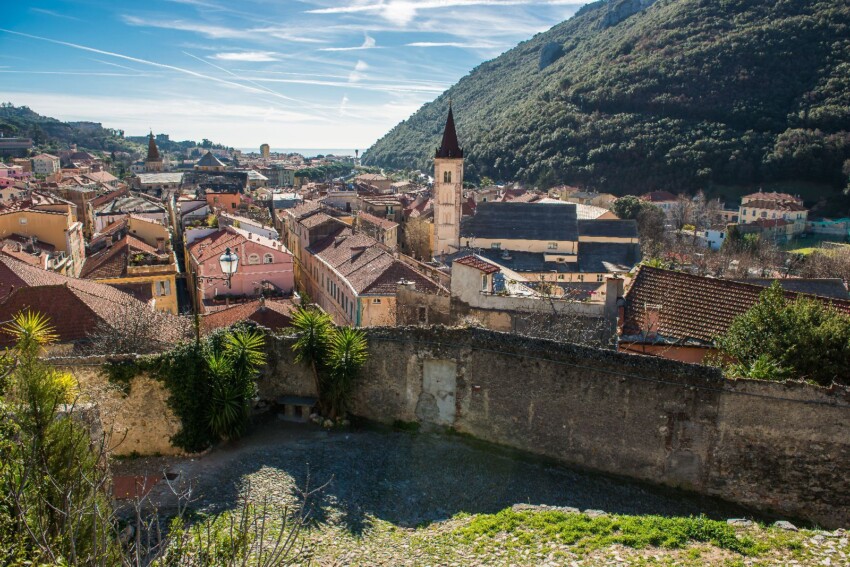
Finalborgo is a medieval town just a stone’s throw from the sea, nestled within perfectly preserved town walls. The locals say that within these walls you feel protected, even pampered, and it’s hard to disagree.
Listed among Italy’s Most Beautiful Villages, this district of Finale Ligure, one of the most vibrant towns on the Riviera di Ponente, is the romantic heart of the city. Every street, every square, every corner hides architectural treasures – be it an opulent palazzo, a monumental church, or one of the magnificent doorways, columns and slate decorative elements that embellish historically rich buildings.
What makes Finalborgo special is that the splendours of the past live alongside a vibrant present, animated by crowds of all ages and a wealth of shops, craft workshops and cafés.
Whilst beach tourism concentrates on Finalmarina, another district of Finale Ligure, Finalborgo has attracted visitors not only through its exceptionally rich cultural heritage but also through the numerous outdoor activities available in its surroundings.
Don’t be surprised if, as you wander through the network of streets in the historic centre, you come across mountain bikers searching for an ice-cream shop to rest after a long ride, or free climbers meeting to swap advice about their next climb.
Finalborgo is rich in fascinating attractions, but the village’s true beauty lies in its special atmosphere. Explore the historic centre at a leisurely pace, using this list of things to see as your starting point.
The Collegiata di San Biagio is a splendid church harmoniously integrated into Finalborgo’s urban landscape. Built in the 17th century on the ruins of an earlier 14th-century church, the project was designed by local architect Andrea Storace.
You’ll easily recognise it by its magnificent late-Gothic bell tower with two-light windows on each side. The façade, though unfinished, is unremarkable, but inside the church is richly decorated.
The Complesso Monumentale di Santa Caterina has its main nucleus in a church built in the mid-14th century following the death of Marchese Giorgio I del Carretto, at the behest of his wife, who wished for a monumental site for the family’s burials.
The original church, in late-Gothic style, was later flanked by two magnificent Renaissance cloisters. Over the centuries the convent underwent numerous modifications and for a period served as a prison (cells housed in the bell tower still remain).
Today it houses an important cultural centre that includes the Museo Archeologico del Finale, a library, a conference hall and exhibition space for shows and events.
Two gates open along Finalborgo’s walls, which once served as the village’s main entrances.
To this day Porta Reale3 remains the principal entry point to the historic centre. However, this 17th-century gate is not the original, which dates from the medieval period.
Porta Testa4 is an authentic medieval gate, though modified in the 19th century with the addition of a small clock tower. The walls in which the gate opens are now incorporated into the buildings flanking it.
It’s still called the Palazzo del Tribunale, but this splendid palace in Finalborgo’s centre is no longer the seat of the courthouse. Its judicial career was nonetheless impressive: it lasted from 1311 to 2013.
Today it hosts local associations and a museum dedicated to the administration of justice and environmental conservation.
The palazzo is one of the finest examples of civil architecture in western Liguria. Take a look at its elegant façade, then visit the museum to appreciate the blend of architectural styles that characterises the building.
The beating heart of Finalborgo’s social and cultural life is found in the charming squares of the historic centre.
The most important is Piazza Giuseppe Garibaldi6, in the heart of the centre, a popular gathering spot for Finale Ligure’s residents. Several fine buildings of Finalborgo overlook this square, including Palazzo Chiazzari and Casa Celesia. The square’s current appearance is relatively recent: until 1956, the 15th-century Truina di San Rocco stood on this site.
Much older is Piazza del Tribunale7, already mentioned in 15th-century historical documents under the name Platea Palatii. The weekly market is held here.
Another 15th-century square is Via Lancellotto8, which represents the front section of the complex of the same name.
Finalborgo’s castle, known as Castel San Giovanni, is a defensive fortress situated 50 metres above sea level.
Built in the 17th century on the remains of an earlier tower (still standing), it has an octagonal plan and sturdy claw-shaped walls. It’s a fantastic vantage point for admiring the historic village, the surrounding valleys and the sea; unfortunately, it’s only open on special occasions.
The Teatro Aycardi is a jewel of Finalborgo, reopened to the public in 2019 after more than 50 years of closure and extensive restoration work.
Built between 1804 and 1806, it is “Liguria’s oldest 19th-century theatre”, as the plaque outside states, and was an important centre of social and cultural life. It features an elliptical auditorium seating up to 250 spectators, two tiers of boxes and a gallery with wooden columns.
You can visit it via guided tours organised by the Museo Archeologico del Finale as part of a distributed museum project.
In the following map you can see the location of the main places of interest mentioned in this article.
There are no beaches in Finalborgo as the village doesn’t face directly onto the sea. To find beaches you’ll need to head to Finalmarina, the coastal district of Finale Ligure, or to other seaside resorts on the Riviera di Ponente; the closest ones are accessible by a local bus departing from Finalborgo.
Accommodation in Finale Ligure is concentrated around the beaches, in the Finalmarina area: there’s a wide choice of hotels, bed and breakfasts and apartments at various prices. In Finalborgo, the number of tourist accommodations is smaller, but the choice is still good: staying in the town centre is certainly more atmospheric.
![[Villa Migliorini] Lusso & Comfort in Finalborgo](https://q-xx.bstatic.com/xdata/images/hotel/max300/526065283.jpg?k=a6aface5877c2d432d9d9d45a9d3a9ece2ec824b6db778cd96069dc0aeeb53a4&o=&a=2394467)


Getting to Finalborgo by car is straightforward – simply take the A10 motorway, which connects Genoa and Ventimiglia, and exit at Finale Ligure.
The main railway station is at Finale Ligure, located in the coastal part of the municipality: from there you can reach Finalborgo by local bus or taxi.
What's the weather at Finalborgo? Below are the temperatures and the weather forecast at Finalborgo for the next few days.
Finalborgo is a district of Finale Ligure, a town in the province of Savona (western Liguria) around 25 km from the provincial capital and over 70 km from Genoa (both to the east).

 Hotel
Hotel  Budget accommodations
  Apartments
  Family Hotel
  Luxury Hotel
  Resorts