Santa Caterina Park Hotel
Sarzana - Terza Traversa Via Cisa
Santa Caterina Park Hotel is in Sarzana's suburbs and offers peaceful gardens and free parking.
Book now
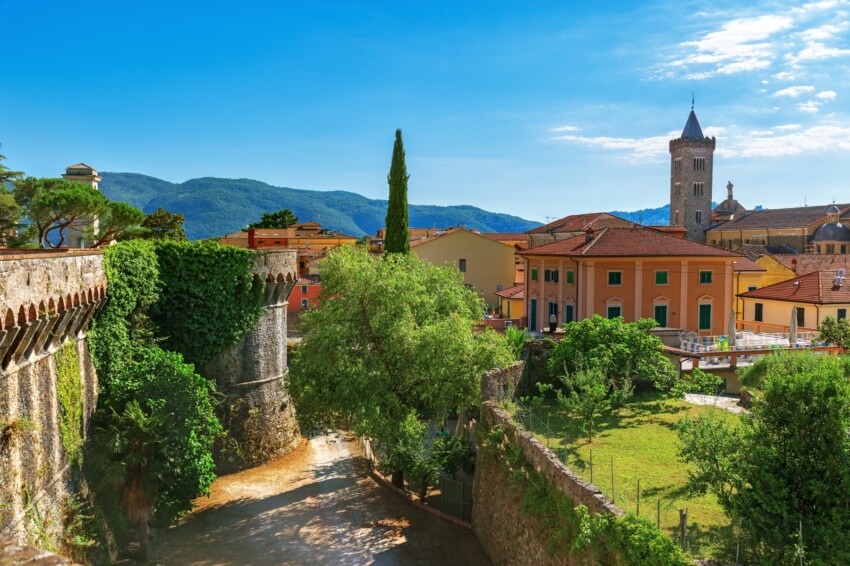
Sarzana is the first town in Liguria you encounter when arriving from Tuscany. The town centre is situated inland, in a plain of the lower Val di Magra dominated by the Sarzanello hill, but an extension of the municipal territory stretches all the way to the sea.
Without needing to venture deep into the region, you’ll already find the essential ingredients that make every holiday in Liguria unique: a historic village, crystal-clear blue sea, and verdant hillsides.
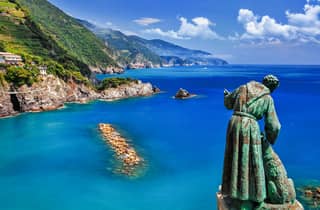
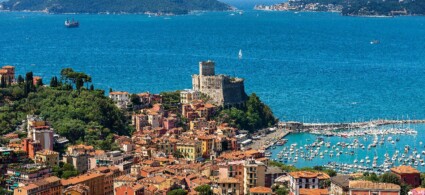
The location is strategic: from here you can easily reach the most beautiful spots on the Riviera ligure di Levante, such as Lerici, Portovenere and the Cinque Terre, but nothing stops you from popping across the border for a day at one of the popular Versilia beaches or exploring the Tuscan part of Lunigiana, a fascinating historic region of which Sarzana is also part.
Without leaving Sarzana, you can admire two magnificent 15th-century fortresses, walls and towers in perfect condition. You can also take part in one of the many events that animate this charming town throughout the year: the Festival della Mente, the Opera Festival, Teatro in Fortezza and La Soffitta nella strada, to name just the most famous.
Some arrive in Sarzana on foot, walking along the ancient paths of the Via Francigena, but there’s no need to exert yourself: you can comfortably get there by car or train. Liguria awaits you, and Sarzana is a worthy calling card for an enchanting region, brimming with natural and historical marvels.
The top attractions in Sarzana are the two 15th-century fortresses. You should also add to your Sarzana sightseeing list a magnificent baroque church, the house where Napoleon’s ancestors lived, green hiking trails, one of the largest Garibaldi statues you’re likely to encounter, and a couple of other interesting sights.
Of the two castles in Sarzana’s territory, Fortezza Firmafede is the one you can see in the town centre, located at the city walls.
This imposing structure, perfectly preserved, is a magnificent example of Florentine military architecture. It was built in the late 15th century on the orders of Lorenzo the Magnificent following an important victory against the Genoese.
With Liguria’s annexation to the Kingdom of Italy, the fortress lost its defensive role; it was first used as a police barracks and later as a prison. Today it houses a museum and hosts events.
Fortezza Firmafede is home to MUDEF, a state-of-the-art museum entirely dedicated to Sarzana’s two fortresses, spanning 27 rooms.
There are no artefacts or historical documents in the Museum of the Fortresses: the story of these two emblematic buildings is told through interactive displays, animated models, immersive cinema and other technologies that make you feel like a character in History itself.
You’ll feel as though you’ve stepped back in time and found yourself face-to-face with knights, soldiers, lords, merchants, priests, pilgrims and peasants who once passed through the fortress halls.
The Sarzanello fortress sits outside Sarzana’s town centre, perched on the hill of the same name. It seems to emerge from nowhere amid the greenery covering the hilltop, but it certainly wasn’t built in this spot by chance: the position is highly strategic. From here, it dominates the Val di Magra, making it possible to control the communication routes between northern and central Italy.
Its origins are probably older than those of Fortezza Firmafede, but its current appearance dates back to the late 15th century, and once again Lorenzo de’ Medici had a hand in its construction.
Today the fortress is open to the public and can be visited independently or with guided tours; there’s also an inn inside that opens for events, themed dinners and by request for groups of at least 20 people.
Piazza Matteotti is Sarzana’s main square and the beating heart of town life. It has an irregular, trapezoid shape, the result of a careful adaptation of the landscape that transformed a former flood plain into an elegant civic square.
Facing onto it are some of Sarzana’s finest buildings, including the Palazzo Roderio, home to the town hall, and the neoclassical Palazzo Podestà-Lucciardi. The historic Caffè Costituzionale, a bar that during the Risorgimento was a gathering place for lively political and cultural discussions, also overlooks the square.
At one end of the square a colonnade opens up, where numerous craft shops once had their premises: perhaps this is what the carved shoe on the capital of one of the colonnade’s pillars is referring to.
The Cathedral of Santa Maria Assunta is Sarzana’s most renowned church and is considered one of the most important in all of Liguria for the artistic value of the works it contains.
The “star piece” is Mastro Guglielmo’s crucifix, the oldest painted cross in Italy. Created in 1138, it’s regarded as one of the most important works of Italian Romanesque painting and depicts Christ with a suffering, human expression, in keeping with the simple spirituality of the 12th century. The cross was repainted in the 14th century but still retains the distinctive features of the original artwork.
Other notable works you can admire inside Sarzana Cathedral are paintings by Francesco Solimena and Domenica Fiasella, as well as some Renaissance sculptures.
The cathedral also houses a relic of the blood of Christ, kept in a chapel to the right of the high altar.
Don’t leave the church without admiring its magnificent organ. Built in the mid-19th century, it has 2,500 pipes and about seventy stops.
A statue that certainly doesn’t go unnoticed in Sarzana’s town centre is Il Genio della Stirpe, a gigantic and in its own way original monument to Giuseppe Garibaldi.
The enormous sculpture, carved from a single block of Carrara marble, depicts a giant holding a shield bearing Garibaldi’s likeness: it’s the symbolic image of the Italian people looking confidently to the future, guided by a great hero.
The sculptor of this towering statue in the centre of Piazza Garibaldi is Carlo Fontana, one of the most important Italian sculptors of the 20th century.
The project dates back to 1907 but the work wasn’t inaugurated until 7 years later.
Porta Romana represents one of the ancient entrances to the town, specifically the southern entrance along the Via Francigena. The gate underwent numerous modifications over the centuries; its current appearance dates to the late 18th century.
As you stroll through Sarzana’s town centre, seek out a picturesque corner with a curious history: the Casa Torre Bonaparte. It’s a building with a lower section in marble featuring two large arches.
It wasn’t the famous Napoleon who lived here, but his distant ancestors – the Buonaparte family who settled in Sarzana in the 13th century. A mercenary member of the family, Francesco Buonaparte “il Mauro”, moved to Corsica at the end of the 15th century, thus establishing the Corsican branch of the Buonaparte family from which the French emperor is descended.
Look for a plaque on the arches between the two windows commemorating these historical events.
Less than 10 km from Sarzana lies one of Liguria’s most important archaeological sites. The official name is quite a mouthful to remember (National Archaeological Museum and archaeological zone of the ancient city of Luni), so the simple name of Luni (or Luna, the city’s original Roman name) is much better. It’s unmistakeable: the historical significance of the finds from this ancient Roman city is unparalleled in the surrounding area.
A visit to the archaeological site takes you inside the ancient walls and also includes a visit to the amphitheatre.
Sarzana is located along the route of the Via Francigena, the trekking route over 2,000 kilometres long that connects England to Rome. The town is the finishing point of the stage that begins in Aulla, and from here you depart for the next stage heading to Massa (17 km the first, 28 km the second).
If you love walking, don’t miss the chance to trek these two stages or part of their route: along the way you’ll see ruins of ancient castles, forests, Roman remains, vineyards, views of the Apuane Alps and the Ligurian Sea.
Sarzana’s town beach is located in the coastal district of Marinella di Sarzana9, less than 10 km from the historic centre and reachable by direct bus.
It’s a long, narrow sandy shore that stretches almost uninterrupted from the eastern edge of Liguria, bordering Massa Carrara, to the mouth of the Magra River; the final section is known as Fiumaretta.
The sand is soft and the waters shallow, making these beaches suitable for inexperienced swimmers and those travelling with small children. There are both free areas and equipped beach clubs.
An attractive pebble beach easily reached from Marinella di Sarzana is Punta Corvo10: the simplest way to get there is to take a boat from Fiumaretta; if you have well-trained legs you can reach it on foot via a trail starting from Montemarcello.
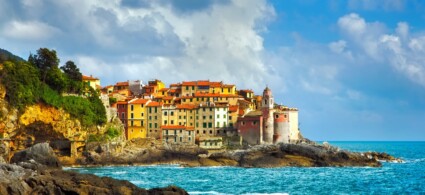
If you fancy a change of scenery, you can easily reach by car the beaches of Lerici and its districts of Fiascherino and Tellaro, or head your car eastwards to check out the Versilia beaches in Tuscany.
If this is your first trip to Liguria, you really should treat yourself to a swim in the Cinque Terre: after all, they’re only 50 km from Sarzana…
In the following map you can see the location of the main places of interest mentioned in this article.
If you want to stay in Sarzana, there are two main areas where you should look for accommodation: the historic centre and the coastal area of Marinella.
In the historic centre there’s a good choice of bed and breakfasts and holiday apartments in Sarzana’s centre, often in historic buildings and tastefully furnished; there are also some charming hotels with good value for money.
Hotels in Marinella di Sarzana are concentrated along the seafront and cater mainly to beach tourism: if you’re after a sea view room, look here.
Near the motorway exit you’ll find some modern hotels designed for business clientele. With parking, they’re very convenient for those travelling by car and suit those wanting high comfort levels.
For a completely different experience, book a holiday home or a room in a farm stay in the green areas surrounding the town.


Driving to Sarzana is straightforward whether you’re coming from Tuscany or Emilia-Romagna. In both cases, just exit at Sarzana motorway junction, just a few kilometres from the historic centre: those from the north will use the A12 Genova-Livorno, those from the south the A15 Parma-La Spezia.
Train is another convenient way to reach Sarzana. The railway station is at the entrance to the historic centre and is served by frequent regional trains to La Spezia, from where you can take regional or Intercity trains to Genoa and all the major resorts on the Riviera ligure di Levante.
It’s also possible to arrive by coach from La Spezia or Santo Stefano Magra.
The nearest low-cost airport is Pisa in Tuscany (about 70 km away); Genoa airport is 110 km away.
What's the weather at Sarzana? Below are the temperatures and the weather forecast at Sarzana for the next few days.
Sarzana lies in eastern Liguria, on the border with Tuscany; administratively, it falls within the province of La Spezia. It's approximately 20 km from the provincial capital and 110 km from Genoa.
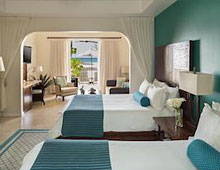 Hotel
Hotel 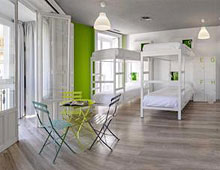 Budget accommodations
 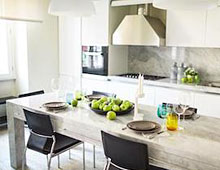 Apartments
  Family Hotel
 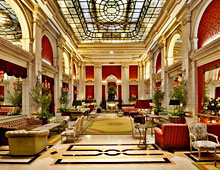 Luxury Hotel
  Resorts