Villa Eva Hotel
Ventimiglia - Via del Ricovero 7
With a terrace, Villa Eva Hotel is located in Ventimiglia, a few steps from the sea.
Book now
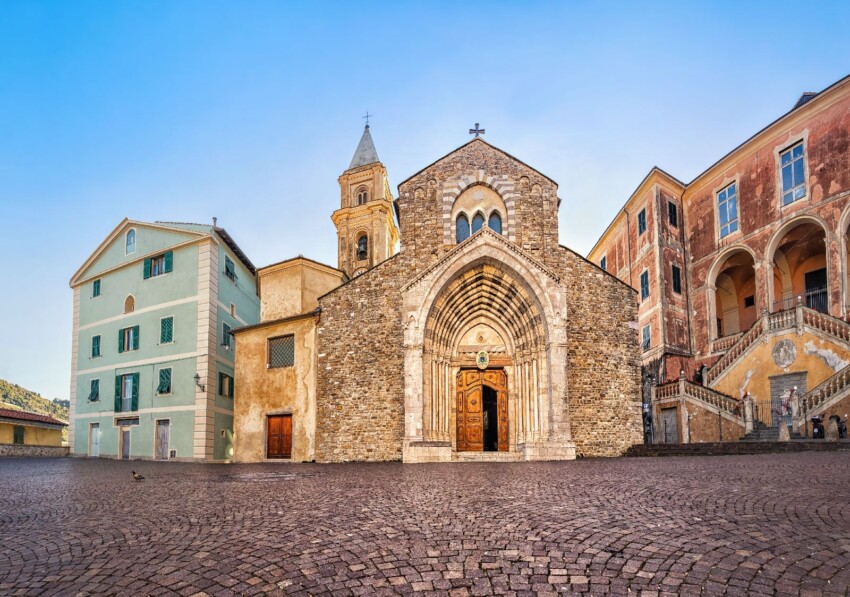
There are places whose fame becomes something of a curse – rather like great actors remembered only for their most commercial film. Such is Ventimiglia, the western gateway to Italy, a border town still firmly Italian yet forever glancing towards France.
The newspapers only remember it when queues of cross-border commuters stretch for kilometres on end, and travel guides spare it barely a few lines. It hardly deserves such treatment: there’s plenty to see and do in the city, and its location is strategically brilliant not just for those working across the border, but also for anyone dreaming of the perfect holiday in Liguria.
Situated at the mouth of the River Roia, Ventimiglia is a city of three distinct characters: ancient, medieval and modern. At the eastern edge of the city lie ruins from the Romanesque and pre-Romanesque periods, remnants of the original settlement.
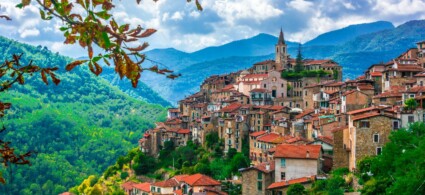
Medieval Ventimiglia, known as the Upper Town, clings dramatically to a hilltop overlooking the right bank of the River Roia, and is the most picturesque and romantic quarter. The modern city sprawls between the historic centre and the seafront, characterised by broad avenues, pedestrianised promenades, countless shops and services – and of course, beaches.
Despite its proximity to glamorous tourist hotspots like Monte Carlo, Nice and Sanremo, Ventimiglia is a relaxed, elegant city that’s refreshingly unpretentious. The stars aren’t far away, but the prices are considerably lower. What are you waiting for?
Archaeology enthusiasts, shopping fanatics, romantic souls seeking inspiration – everyone will find something to see in Ventimiglia!
The must-see attraction in Ventimiglia is the Red Rocks Caves, a remarkable prehistoric site right on the seafront where a single ticket gives you access to both breathtaking scenery and artefacts thousands of years old.
These are natural fissures and cavities at the foot of an imposing limestone cliff that served as dwellings for prehistoric peoples for tens of thousands of years. This means that an enormous wealth of archaeological finds accumulated inside and around the caves – everyday objects alongside primitive forms of artistic expression.
The significance of this site was well understood by English philanthropist Sir Thomas Hanbury, an extremely wealthy businessman who spent his final years in nearby Mortola: it was his idea to open a prehistoric museum so everyone could view the artefacts found in the area. In 1994 the museum was expanded with a new building.
The entire complex comprises two groups of caves, divided by the railway line. North of the railway are the Conte Costanini Cave, the Children’s Cave, the Florestano Cave, the Caviglione Cave and the Prince’s Cave; to the south is the Barma Grande (another cave, the Barma du Bausu da Ture, was destroyed by quarrying operations).
Some caves can be visited inside; entry is included in the museum ticket.
Did you know that one of Europe’s largest outdoor markets takes place in Ventimiglia? You probably did! The Ventimiglia Friday market is a true institution, though in many ways similar to outdoor markets throughout Italy. It’s the sheer size that’s made it famous: countless stalls selling everything under the sun, including more than a few counterfeit branded goods.
For locals, shopping at the Friday market is a habit; for tourists it’s a pleasant way to pass the time. If you fancy doing some shopping yourself, head to the seafront and riverside on Friday mornings through late afternoon.
The Red Rocks Museum isn’t the only marvel that English philanthropist Hanbury left as his legacy to Ventimiglia: he also created magnificent botanical gardens considered among the finest in Europe.
Taking advantage of Liguria’s mild climate and collaborating with important agronomists and landscape architects, Thomas Hanbury succeeded in creating an acclimatisation garden for exotic plants in the grounds of an elegant villa he owned in the Mortola area.
Scientific research and aesthetic sensibility are the guiding principles of this masterpiece of 19th-century landscape gardening. Strolling along the pathways of the Hanbury Botanical Gardens and admiring vigorous plants from around the world, it’s easy to feel like a nobleman from another era, lost in rapturous contemplation of nature.
Perfect for respite from summer heat and city stress, these gardens are a must-see attraction and an excellent vantage point for stunning sea views.
Built in the 12th century, Porta Canarda opened along Ventimiglia’s defensive walls and represented one of the main entrances to the city in medieval times. Perfectly preserved, it’s topped by a tower once used for defence and adorned with a marble bas-relief.
Ventimiglia’s main square is dominated by the magnificent Cathedral of Santa Maria Assunta, built in Romanesque style in the 10th century, probably on the remains of an ancient pagan temple dedicated to Juno; the portal, three apses and presbytery are later additions.
Another fine religious building in Ventimiglia is the Church of San Michele Arcangelo in Piazza Colletto, in the city centre. This church also dates from the 10th century and was enlarged in subsequent centuries; it currently has a single nave, though until 1628 it had three.
Look inside for three Roman milestone stones from the ancient Via Julia Augusta. Here’s a hint: one of the three is used as a holy water font and bears the number 590, indicating the miles’ distance from Rome.
What was Ventimiglia like in Roman and pre-Roman times? Find out by visiting the city’s archaeological site: you can see the remains of Albintimilium (the city’s ancient name), including a theatre, baths, a stretch of the Via Julia Augusta, houses, mosaics and walls.
The visit also includes the Antiquarium, a museum displaying archaeological finds from the area and reconstructions of ancient buildings. Among these is a reproduction of the Gate of Provence, dating from the 1st century BC, once situated along the perimeter walls on the western side of the archaeological site.
Three fortresses once defended Ventimiglia against attacks from invaders by land and sea.
Two of these, Castel d’Appio and Forte San Paolo, are now mere ruins, whilst the Fortezza dell'Annunziata8 remains well preserved, perched atop a rocky promontory towering above the sea.
Built between 1831 and 1836 at the behest of the House of Savoy on the site of a former convent, it was soon converted into a military base. Since 1938 the main floor of the fortress has housed the MAR - Girolamo Rossi Civic Archaeological Museum9, named after the discoverer of the ancient Roman city of Albintimilium.
The fortress deserves a visit for its stunning panoramic views over the Red Rocks, Hanbury Gardens and modern Ventimiglia; on the clearest days your gaze can reach as far as Cap Estérel.
Ventimiglia lies roughly halfway between Sanremo and Monaco, just over 6 km from Bordighera: from here you can make wonderful day trips to the most beautiful spots on the Ponente Riviera. If you fancy popping across the border, the principality of Monaco, Nice and other enchanting Côte d’Azur locations are easily reached for a day visit.
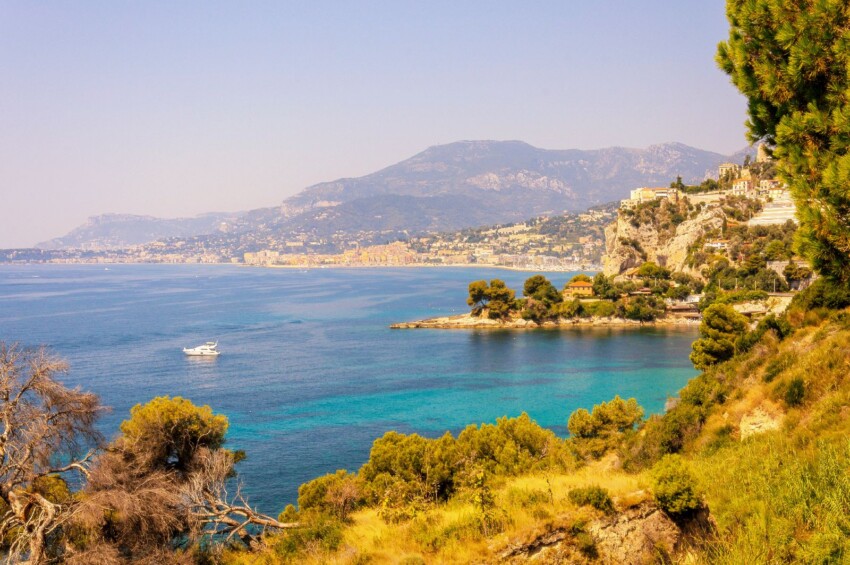
Why Ventimiglia never became one of Liguria’s top beach destinations is a mystery. Its position is enviable: a junction between the much-vaunted Côte d’Azur and the Riviera dei Fiori, the city boasts a coastline dotted with enchanting beaches, bays and inlets washed by the typical clear azure waters that characterise the stretch of coast between France and Italy.
Without leaving Ventimiglia you’ll find three delightful beaches where you can spend lovely hours relaxing in the sunshine.
Ventimiglia’s most famous beach is the Red Rocks Beach, nestled between wonderful sea and the tall cliff face where the namesake caves open up. It’s a beach of pebbles and flat rocks; the sandy seabed drops away steeply and is teeming with fish, which is why the beach is much beloved by divers.
To get there, park your car and walk along a pedestrian path about 200 metres long of exceptional beauty.
Just steps from the Red Rocks, heading east, you’ll find another pebble beach, often considered a continuation of the first. It’s called the Eggs Beach for the sculpted shape and brilliant white colour of the pebbles, or Little Red Rocks Beach10 after the beach establishment name.
Set in an evocative inlet, it’s an exclusive, small, privately-run beach (with no free areas): perfect for those wanting to sunbathe with style and dive into crystal-clear water in a thousand shades of blue.
You can arrive by car or boat and in both cases you’ll be welcomed by the beach establishment staff with first-class service; there’s also an elegant fish restaurant.
If you prefer sandy shores, the beach for you is Calandre Beach11, Ventimiglia’s quintessential city beach. Located on the modern city’s seafront, it’s a stretch of soft golden sand with both free and equipped areas.
It’s also suitable for those travelling with small children as it’s easily accessible, well-serviced and the seabed slopes gently, allowing safe bathing.
Beyond the western bank of the River Roia, this beach is backed by a cliff covered in dense vegetation: the landscape here is wilder and on windy days the beach is a popular spot for surfers.
In the following map you can see the location of the main places of interest mentioned in this article.
The choice of hotels, bed & breakfasts and apartments in Ventimiglia is very wide: some cater to people commuting to France for work, whilst others are specifically designed for tourists wanting to enjoy the beauty of the coast. There are options for all budgets and on average prices are lower than in more famous beach resorts in Liguria.
Almost all accommodation in Ventimiglia is concentrated on the modern city’s seafront, though you can find hotels and B&Bs in the historic centre too. If you prefer apartments and houses surrounded by greenery, head a few kilometres away.
We offer a selection of hotels at Ventimiglia to suit all categories of travellers. The most booked by tourists are the sea-facing hotels, often right on the beach. If you want to play it safe, choose one of the following: they are among the most booked hotels in Ventimiglia, sorted by number of reviews.


If you prefer space, privacy and the ability to prepare your own meals to a hotel holiday, book a holiday home at Ventimiglia. We recommend a few below, but in this case we advise you to book early because houses and apartments for rent at Ventimiglia are in high demand.


Reaching Ventimiglia by car is straightforward from any direction: from the east, the A12 motorway gets you there quickly; if coming from France take the A8, whilst from Piedmont (Cuneo area) the most convenient route is the SS80.
Reaching Ventimiglia by train is also very easy as the city lies on railway lines to Nice and Genoa, served by numerous regional and Intercity trains. Thanks to its special location, Ventimiglia is often a stop for long-distance coaches heading towards France; it’s also reachable by local buses from all major Liguria resorts.
If flying in, consider a flight to Nice rather than Genoa: the French airport is much closer (only 45 km rather than 155 km).
What's the weather at Ventimiglia? Below are the temperatures and the weather forecast at Ventimiglia for the next few days.
Ventimiglia is a municipality in the province of Imperia (western Liguria), approximately 50 km from the regional capital. Genoa is 160 km away, whilst Monte Carlo and Nice are much closer, at just 25 km and 40 km respectively.
 Hotel
Hotel  Budget accommodations
  Apartments
  Family Hotel
  Luxury Hotel
  Resorts