Talking Stones
Dolceacqua - Via San Bernardo 7
Located in Dolceacqua, Talking Stones is characterised by exposed stone walls in all rooms.
Book now
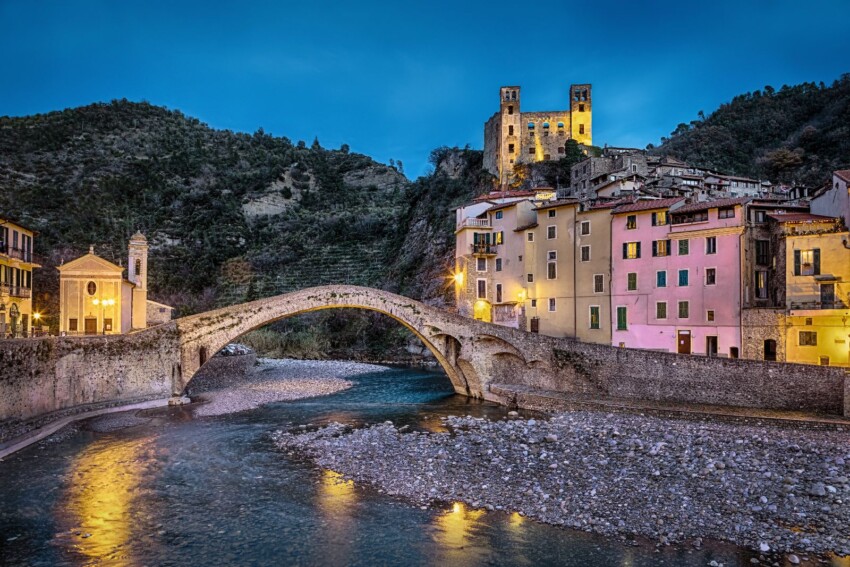
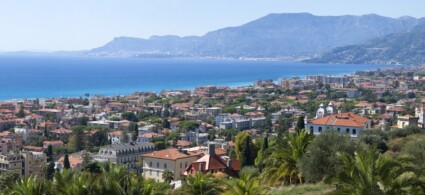
One of Liguria’s most beautiful villages is Dolceacqua, a gem nestled in the lush Val Nervia, at the foot of Monte Rebuffao. It boasts all the advantages of Liguria: mild climate, a favourable position for both sea and mountains, delicious local dishes and generous vegetation including olive groves, vines, Mediterranean scrub and beautifully fragrant ornamental plants.
A stream divides it into two distinctly different areas: the Tera is the historic heart of the village, a charming cluster of stone houses and historic buildings on the mountainside, whilst the Borgo is a more recent zone situated in the valley on the other side of the stream.
The link between the two areas is the enchanting Ponte Vecchio, the ideal starting point for exploring the centre. From here, a network of caruggi—typical narrow medieval lanes of Ligurian villages—leads to Dolceacqua’s top attraction: the austere yet equally evocative Castello dei Doria.
Over the centuries, this small village has charmed many illustrious guests. As early as the late 19th century, French painter Monet fell in love with it and celebrated its poetry and beauty in his works. Renoir and Napoleon also came from France: the latter so loved the local wine that he had a crate sent to France.
Today, Dolceacqua continues to attract artists and politicians, joined by famous figures from music, sport and television. It will surely enchant you too.
The attractions in Dolceacqua are concentrated in the Tera and (despite some uphill walking!) are easily reached on foot.
There are plenty of hidden treasures in this small historic centre, so take your time and explore at a leisurely pace. The best way to fall in love with Dolceacqua is to lose yourself in its caruggi without a set itinerary—you’ll easily stumble upon the most beautiful sights along the way.
The village of Dolceacqua is dominated by the Castello dei Doria, a typical medieval fortress perched on a hilltop and arranged on multiple levels. Its origins are uncertain, but the castle is already mentioned in historical documents from the 12th century, and it certainly passed into the hands of the Doria family in the second half of the following century.
Despite its austere and mysterious exterior, the fortress is particularly evocative, enhanced by the verdant setting surrounding it. Impressionist painter Claude Monet was also captivated by it, depicting it in a celebrated painting titled “Le Chateau de Dolceacqua“, now on display in a Paris museum.
Thanks to restoration completed in 2018, visiting the castle has become an absolute must for all Dolceacqua visitors. The panoramic path leading to the castle entrance offers splendid views of the valley, the sea and expanses of olive groves and vineyards.
The castle’s rooms feature a multimedia journey recounting the history and traditions of Dolceacqua, memories of rural life, the history of the area’s most influential families (the Doria and Grimaldi) and Dolceacqua’s connections to the Principality of Monaco.
The castle is also used as a venue for cultural events, conferences, corporate functions and weddings.
One of Dolceacqua’s most iconic images is the Ponte Vecchio, the romantic stone bridge spanning the Nervia stream and connecting the Borgo to the Tera. It’s a single-arch bridge in Romanesque style, built in the 15th century.
To the left of the bridge stands a private chapel, the Church of San Filippo Neri, whilst on the opposite bank is a fresco depicting Andrea Doria, one of Dolceacqua’s lords.
Following the maze of caruggi from the Ponte Vecchio up to the Castello dei Doria, you’ll encounter one of Dolceacqua’s most characteristic corners: the Piazzetta dell’Armatore. The centre of this small cobbled square is marked by a stone mosaic representing the coat of arms of the Grimaldi/Doria family.
From here begins the lively Via del Castello, a narrow lane flanked by shops, craft workshops, art studios and osterias.
An unusual attraction to find in a historic village is Dolceacqua’s Visionarium 4D, a 3D and Omnimax cinema showing short nature documentaries (from 10 to 30 minutes).
Large screens, special effects and music combine to amplify the wonder of natural spectacles presented in the documentaries, creating an immersive experience that makes you feel as though you’re in the magnificent locations you’re watching on screen.
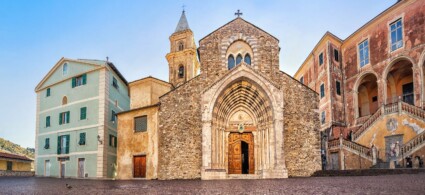
The parish Church of Sant’Antonio Abate is a religious building dating back to the 15th century. The bell tower’s base is a square-shaped angular tower that once formed part of the village’s walls and has been incorporated into the church’s architectural complex over time.
Inside the church, you can admire a polyptych panel painting by Ludovico Brea, a 16th-century artist considered the leading figure of Ligurian-Nicois painting of his era.
From the sacred to the secular: the other attraction on Piazza Mauro, the same square facing the Church of Sant’Antonio Abate, is the Fontana del Rossese, a monument through which the city celebrates its most famous local product.
Be warned, though—the Rossese from this trough-shaped fountain is merely a name: what flows out is a liquid coloured red to recall the DOC wine of the region. Not only is it not wine, but it’s not even drinkable. Best to know this beforehand so you’re not disappointed!
Don’t worry though—the restaurants and wine bars in the centre will give you plenty of opportunities to taste this generous red, with its intense yet delicate aroma and soft flavour. And do snap a photo in front of this curious fountain!
If you’re interested in wine, don’t settle for just a glass with dinner: visit the local branch of the Enoteca Regionale della Liguria, an institution dedicated to promoting and showcasing the region’s wine and gastronomic heritage.
The venue is located at the foot of Castello Doria and organises guided tastings; you can also purchase wine to take home with expert advice from the staff.
Palazzo Luigina Garoscio, or Palazzo Doria Garoscio, is an elegant 17th-century building that belonged to Dolceacqua’s richest and most influential families.
The palazzo’s name honours a generous woman from the Garoscio family who left Dolceacqua for love and went to Argentina. She never forgot her homeland: in the 1920s, she donated this splendid palazzo to the municipal administration.
The original decorations adorning the vaults of the main rooms are still visible, as are two magnificent slate fireplaces, likely transferred to this palazzo from other stately Doria residences between the 19th and 20th centuries.
The building was restored in 2005 and now houses the town’s most important cultural institutions: the library, historical archive, art gallery and tin soldier museum.
If you’re an art enthusiast, take a look at the municipal art gallery of Dolceacqua, which displays the private collection of local artist Giovanni Morscio (1872–1972), donated by him to the city.
The collection comprises works by the philanthropic artist himself as well as pieces by French and Italian artists of his time.
Part military museum, part toy museum, the Piccolo Museo del Soldatino in Dolceacqua is a free attraction worth spending some time on.
Small but well-maintained, it displays tin soldiers from different eras and military branches, including carabinieri, alpine troops, templar orders and armies from around the world; there’s also a section dedicated to mythology and fantasy miniatures.
From the centre of the Borgo, a short walk along the Nervia stream brings you to the Church of San Giorgio. It’s a fine example of a 12th-century Romanesque church, with notable Gothic and Baroque elements from later periods.
The church’s crypt houses the tombs of Stefano and Giulio Doria.
Most tourists visiting Dolceacqua confine their exploration to the Tera, the historic centre, without glancing at what lies on the other side of the Nervia. If your visit isn’t just a quick dash, make the effort to cross the river and discover Dolceacqua’s other side.
Though more modern, this area is not without fine buildings and points of interest, including the Church of San Sebastiano10. The Borgo is also Dolceacqua’s commercial centre: its main street is the classic shopping street.
A curiosity: Gerolamo Novaro, father of Michele Novaro (composer of our national anthem), once lived in this part of Dolceacqua. A commemorative plaque is mounted on his house wall.
In the following map you can see the location of the main places of interest mentioned in this article.
A stay in Dolceacqua is also an opportunity to immerse yourself in nature and pursue outdoor sports. The two most popular are hiking and mountain biking, but you can also enjoy horse riding, tennis or football matches.
The countryside around Dolceacqua offers numerous opportunities for beautiful walks. A lovely trail suitable for everyone leads to the Sanctuary of Our Lady of Sorrows, a church east of the village built in the late 19th century and now a pilgrimage destination for local devotees.
The path continues up the same route leading to the Castello dei Doria: it’s a pleasant walk with views over olive groves and, on the second stretch, wonderful panoramic views of the sea. If you prefer to avoid the climb, you can reach the sanctuary by car on a paved road starting near the municipal sports facilities.
Another fine religious building reachable on foot from the centre is the small Church of San Bernardo: unfortunately not well preserved, but set in lovely green surroundings that make it equally enchanting, and once there you’ll enjoy fine panoramic views over Dolceacqua.
You climb along an old mule track encountered near Via San Bernardo. It takes about 30 minutes to reach the chapel from the village; if you want a longer walk, you can continue to the ruins of the Convent of the Augustinian Fathers.
Another easy walk takes you from Dolceacqua to Terre Bianche, a vineyard area where the celebrated Rossese DOC wine is produced.
Prefer challenging treks with significant elevation gain over easy walks on well-trodden paths? There are plenty of trekking trails starting from Dolceacqua, with the most beautiful leading to Monte Abellio (approximately 950 metres elevation) and Torre Alpicella (500 metres elevation).
Another trail recommended for experienced hikers is the Sentiero degli Alpini, a vertiginous path carved into the rock in the 1930s for military purposes.
The trail is part of the Alta Via dei Monti Liguri, a fascinating trekking route that lets you explore Liguria’s interior on foot: it starts right in the Val di Nervia and passes through Dolceacqua. Some sections suit everyone, whilst others are reserved for experienced hikers due to steep passages, uneven terrain and steep climbs.
Dolceacqua is a very popular destination among cycling enthusiasts—and we mean everyone from weekend amateurs to award-winning athletes like Sam Hill, world champion of enduro and downhill, and Tour de France winners such as Primoz Roglic and Egan Bernal.
Experienced riders can tackle thrilling trails loved by champions, whilst those wanting a relaxing pedal can use the cycle path that runs from Dolceacqua to Ventimiglia’s seafront promenade.
The cycle path follows the left bank of the Nervia stream, presents no technical difficulties and lets you reach the sea in approximately 20–25 minutes.
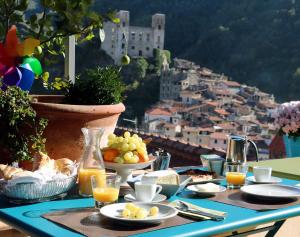
Staying in central Dolceacqua is a unique experience. The Tera’s accommodation is housed in characteristic stone buildings and is beautifully detailed, perfect for a romantic weekend, a special occasion or a pampering holiday. Some offer panoramic terraces with views of the cascade of rooftops across the historic centre or the valley.
There are no hotels in Dolceacqua, but you’ll find a wide choice of luxury bed and breakfasts, simple guesthouses, well-furnished apartments and room rentals.
If you want to spend less, look for accommodation in the Borgo: the centre is very close and easily reached on foot or by public transport without needing to move your car.
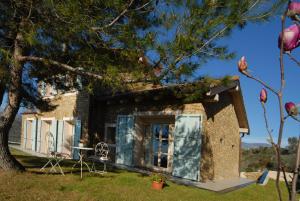
For a countryside holiday, venture a bit further and book a holiday home or farm stay in the Dolceacqua area; there’s also a campsite.

Driving to Dolceacqua is straightforward: take the A10 motorway and exit at either Ventimiglia or Bordighera, then continue on the SS1 Aurelia road until you reach the Val Nervi provincial road (SP64). Once you arrive in Dolceacqua, you’ll need to leave your car outside the historic centre: there are both free and paid car parks in the immediate vicinity.
If you’re travelling by public transport, the easiest way to reach Dolceacqua is to take a train to Ventimiglia and then continue by local buses. Ventimiglia station is well served by regional trains to Genova, and bus services run fairly frequently, though it’s always worth checking official timetables in advance to plan your journey.
Another option is to take a train or bus to Sanremo and then continue on local buses from there.
The nearest airport is Nice, in France, roughly 50 km away; the closest Italian airport is Genova (160 km). Both are served by budget airlines.
What's the weather at Dolceacqua? Below are the temperatures and the weather forecast at Dolceacqua for the next few days.
Dolceacqua is a municipality in the province of Imperia situated inland from the western Ligurian coast, just 10 km from the sea. The provincial capital is about 60 km away, Genoa is 170 km away; much closer is the French border (20 km) and the Principality of Monaco (35 km).
 Hotel
Hotel  Budget accommodations
  Apartments
  Family Hotel
  Luxury Hotel
  Resorts