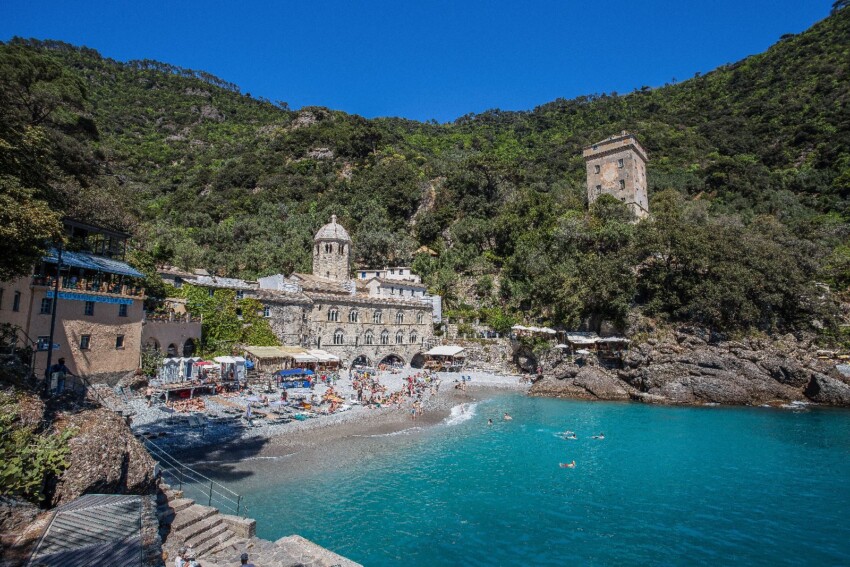
Hidden within the verdant Portofino Park lies a truly distinctive Benedictine monastery: the Abbey of San Fruttuoso, an architectural marvel harmoniously nestled in a breathtakingly beautiful natural setting.
Legend has it that San Fruttosio himself may have indicated the location where his relics were to be safeguarded. What is certain is that the tiny Capodimonte Bay (often referred to more simply as San Fruttuoso Bay) proved perfect for hosting an important place of worship: difficult to access, invisible from afar and blessed with a freshwater spring.
This fortunate combination of factors made it possible to construct a remarkably evocative building that over the centuries served as a monastery, then a pirate’s lair, a fishermen’s refuge and finally the property of the Doria princes; in 1983 it was donated to the FAI, restored and now opened to the public.
Arriving by sea is an emotive experience: as you round the rocky promontory of Punta Chiappa, the abbey’s tower will peek through the dense vegetation and gradually the church will reveal itself in all its splendour.
Arriving on foot is far more strenuous, but as the heat and steep climbs threaten to overwhelm you, this magical place will draw you towards it. Here too it will unfold gradually, yet a single glance will be enough to captivate you with its unique blend of mystery, elegance and solemnity.
An ideal day trip to the Abbey of San Fruttuoso should include a visit to the monastic complex, a few hours of sunshine on the beach and finally some leisurely time in the village.
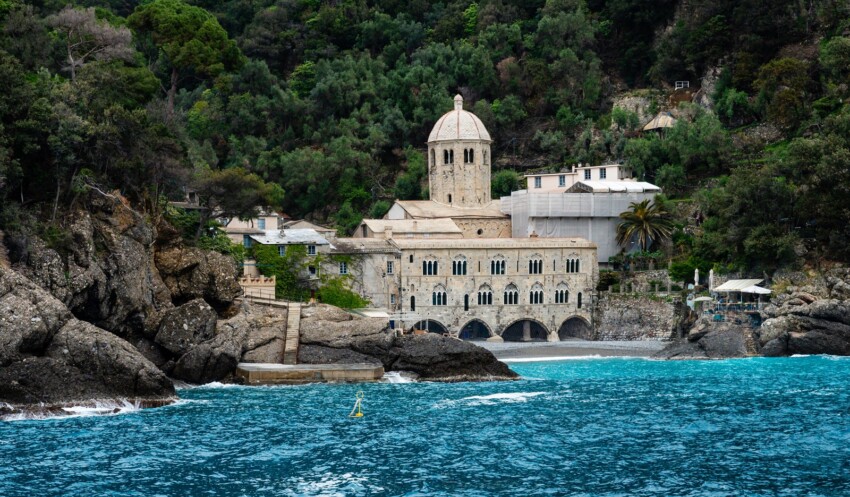
The San Fruttuoso monastic complex is unique in its kind: whilst nestled in the greenery and silence of the woodland like many other medieval monasteries, it stands out for its singular seaside location.
The original nucleus was built between the 10th and 11th centuries, with the cloister added in the 12th century and later modified by the Doria princes. The original tower dates from the 10th century, though it was subsequently topped by an octagonal tower (the one we see today).
The building facing the sea is the abbey’s most recognisable image: added in the 13th century, it is characterised by two tiers of triple-light windows that give it the appearance of a noble palazzo.
During your visit you’ll also see the ancient tombs of the Doria family dating from the period 1275-1305 and a Roman sarcophagus.
After exploring the abbey you can relax on the small beach facing it and swim in the crystal-clear waters of the bay. San Fruttuoso Beach is a narrow strip of pebbles between the monastic complex buildings and the sea; it’s divided into a equipped section and a free section.
During the middle hours of the day it’s always very crowded, so we recommend arriving early to enjoy the beauty of the place at a more leisurely pace. Even if you find it packed with visitors you won’t be able to help falling for it: few beaches anywhere in the world can boast such an enchanting setting.
If you’re into diving, you can venture down to 10-15 metres depth to admire up close the Christ of the Abyss, a bronze statue depicting Jesus with his hands raised heavenwards, forged to commemorate the victims of the sea and now a popular diving site as well as a spectacular location for underwater weddings.
No matter if you’re not a diver: the clarity of the water makes it possible to see the statue without submerging.
Once you’ve visited the abbey and sunbathed on the beach in front of it, there’s little else to do in San Fruttuoso, yet we would strongly urge you not to leave hastily like most tourists, but to stay longer, preferably until the last ferry.
The village is little more than a scattered cluster of houses gathered around the monastery: it’s a magical place that truly comes alive once the tourist crowds have left and silence reigns supreme.
There are a couple of places where you can grab a bite, but there are no shops: bear this in mind if you prefer a packed lunch.
There are no hotels or bed & breakfasts in San Fruttuoso village, except for a charming residence run by the FAI. The location is part of the municipality of Camogli: simply head to the town centre or the surrounding hills to find a good range of accommodation; Portofino is even closer, but hotel and bed & breakfast prices are higher. Alternatively, you can stay in Santa Margherita Ligure.
Many travellers visit the Abbey of San Fruttuoso on a day trip from Genoa or from the more famous tourist resorts along the Riviera di Levante: choosing these locations as your base gives you access to a wide range of accommodation for all budgets.
The simplest way to reach the Abbey of San Fruttuoso is by sea. Tourist ferries depart year-round from Camogli; during the summer months ferries operate from Recco, Portofino, Santa Margherita Ligure, Rapallo, Sestri Levante, Lavagna, Chiavari and Genoa.
Another option is to reach San Fruttuoso on foot along the trails of the Portofino Natural Park, though you’ll need suitable footwear and good physical fitness; this option is not recommended for those travelling with young children.
For train travellers, the nearest station is Camogli-San Fruttuoso, located in the historic centre of the municipality just 550 metres from the ferry departure point.
It’s not possible to reach San Fruttuoso by car.
The village of San Fruttuoso falls within the municipality of Camogli, a charming town on the Riviera di Levante that sits to the west of the Portofino headland, roughly 20 km from Genoa.





 Hotel
Hotel  Budget accommodations
  Apartments
  Family Hotel
  Luxury Hotel
  Resorts