Autosiloport Genoa Cruise Parking Undercover
1278 reviews
Book now
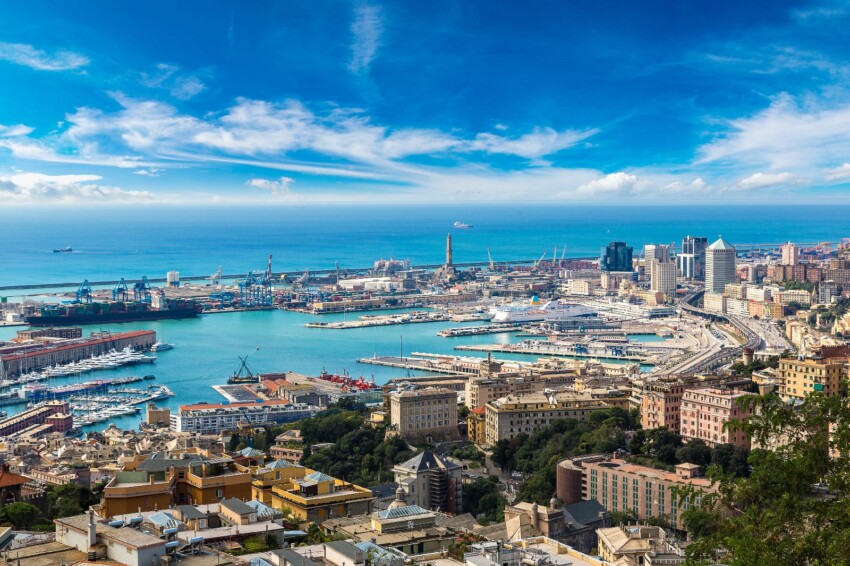
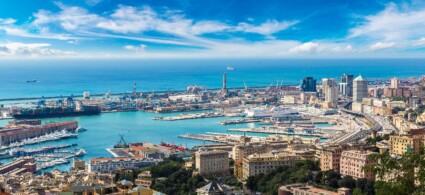
Of ancient origin, Genoa’s port has been the city’s primary source of wealth for centuries and has established itself as Italy’s leading port by size, number of shipping lines and employment opportunities.
The figures are impressive: the ferry terminal alone handles 2.5 million passengers and 700,000 vehicles annually. The cruise ship terminal features two passenger terminals; each can simultaneously berth two state-of-the-art vessels, with an overall movement of 10,000 passengers daily in one case and 8,000 in the other.
Today it presents itself as a complex organisation comprising four distinct areas.
The first you encounter coming from the city centre, easily accessible on foot, is the Porto Antico (Old Harbour): the basins and warehouses of the original port nucleus have become a vibrant social hub with numerous venues. This is where the city’s maritime-themed tourist attractions are concentrated, including the celebrated Aquarium, considered Genoa’s top attraction.
Moving westward, you’ll find the Maritime Station, where cruises depart; followed by the Ferry Terminal. Beyond this lies the vast commercial port, the arrival and distribution point for container ships.
Genoa’s port stretches between the sea and the city’s historic centre and is easily accessible by various means.
Using the Cruise Ship Maritime Station as a reference point, which sits midway between the Porto Antico and the ferry terminal, it’s only 600 metres from the central railway station (Genova Principe). If you arrive in Genoa by train, you can reach the port on foot, or by taxi at most if you have heavy luggage. Near the train station there’s also a coach station serving long-distance buses connecting Genoa to numerous Italian cities.
If you’re arriving from other parts of Genoa, you can take the metro and get off at Darsena or Dinegro; the distance from the metro stop to the Maritime Station is roughly 850 metres.
The convenience of a car remains unbeatable. Genoa sits at the centre of an extensive motorway network comprising the A7 Milan-Genoa, the A10 Ventimiglia-Genoa, the A12 Livorno-Genoa, the A26 Gravellona-Toce-Genoa, and allows you to arrive easily from across northern-central Italy.
The port area is a sort of city within the city, a crossroads of vehicles and people at all hours of the day and night. For those unfamiliar with the area, hunting for a free parking space can be complicated, and one-way systems and traffic certainly don’t help.
The few parking spaces around Genoa’s port are all marked with blue lines, so you might as well avoid wasting time searching and book paid parking before you leave. This will save you time and money because online parking rates are always more competitive than what you’ll pay on the spot.
Within a short distance of the cruise and ferry terminals, you’ll find several covered and open-air car parks open 24 hours a day and under video surveillance. The shuttle service is generally free, but before booking check whether your chosen car park has any special conditions (for example, if it’s reserved for cruise passengers only).
For even greater convenience, you can request the valet parking service, which means you don’t even have to worry about finding a parking space and getting from there to your departure point. Go directly to your ship’s departure terminal: a driver will be waiting to collect your car and return it to the same place on the date you specify when booking.

Genoa is a historic cruise tourism destination, not just in Italy but across Europe. One of the industry’s most important companies, Costa Cruises, was founded here in the mid-19th century, and Genoa’s port has long been a major hub for those who love sea-based travel.
Cruises departing from Genoa are typically one-week Western Mediterranean cruises with stops in Italy, France, Spain and Malta; the ships belong to both Costa Cruises and other major operators such as MSC. Among the enchanting destinations you can visit on this type of cruise are the cities of Barcelona, Cannes, Valletta, Marseille, Naples, Palermo, Catania and the islands of Majorca and Ibiza.
Genoa also serves as a home port for longer cruises to the Middle East, North Africa, the Mediterranean, Northern Europe and the Americas.
The ferry can be a valid alternative to flying, especially if having a car at your destination is convenient for getting around. If that appeals to you, Genoa is one of Italy’s best ports, as it’s served by ferries departing to and arriving from both domestic and international destinations.
From Genoa you can take ferries to Italy (Sicily, Sardinia), France (Corsica), Spain (Barcelona), Morocco (Tangier Med), Tunisia (Tunis) and Algeria (Skikda).
| Routes | Companies |
|---|---|
| Golfo Aranci - Genoa |
|
| Olbia - Genoa |
|
| Palermo - Genoa |
|
| Porto Torres - Genoa |
|
The Genoa Port Authority falls under a higher-level body, the Maritime Authority of Genoa, located at the eastern end of the Porto Antico.
This is also a local office of the Ministry of Infrastructure and Transport, which is responsible for navigation safety and administrative management of all major maritime activities.
It’s generally not an office of interest to tourists, but should you need to contact them, the official Coast Guard website provides contact details and opening times.


 Hotel
Hotel  Budget accommodations
  Apartments
  Family Hotel
  Luxury Hotel
  Resorts