Hotel Sud Est by Fam Rossetti
Lavagna - Previati 200
The Hotel Sud Est by Famiglia Rossetti is located in Lavagna, 500 meters from a partner private beach, from 01 June to 15 September included in the hotel rates.
Book now
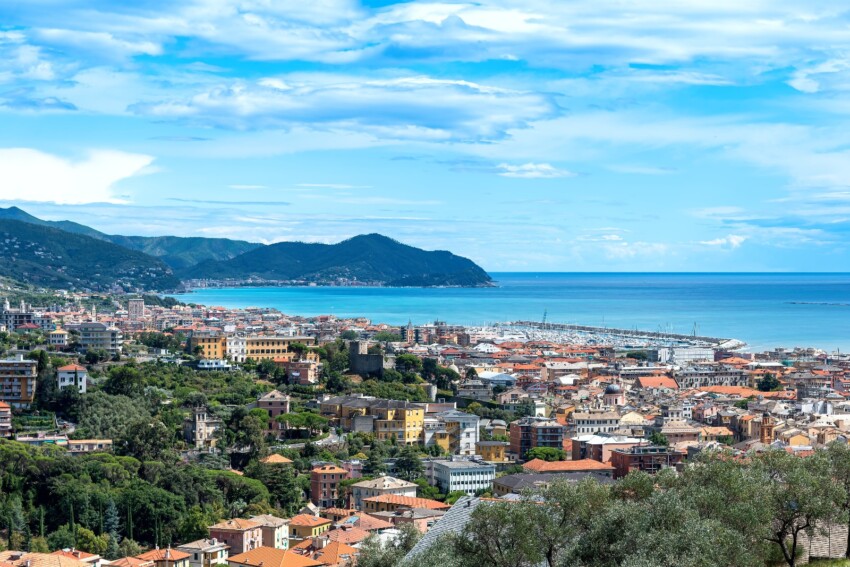
There’s a town in Liguria that lends its name to the object symbolising school interrogations – the terror of every student – yet a place where school, and work for that matter, is instantly forgotten. Welcome to Lavagna, a coastal town in the province of Genova nestled along the Gulf of Tigullio.
Its beach is the longest along the entire Riviera di Levante and welcomes thousands of locals and holidaymakers each year, all keen to recharge their batteries with a dip in the sea and a siesta in the sun. It’s easily accessible by car, train and boat – indeed, recreational boating is one of the town’s main activities.
The name derives from the Latin Lavania, which later became Lavagna; Lavagna stone is the name given to slate – that distinctive black stone from which traditional school blackboards were made (hence the word “lavagna” for blackboard).
Slabs of slate from the nearby quarries on Monte San Giacomo were transported to countries throughout the Mediterranean and Northern Europe aboard a distinctive vessel known as a leudo. The French poet Paul Valéry spotted them during his Grand Tour of Italy and celebrated them in a famous poem.
Another illustrious figure from European literature to pass through these parts was English poet Lord Byron, who is credited with the idea of planting sea lilies along the Gavi beach shore.
Join the artists and poets of yesteryear and today’s beach-goers in choosing Lavagna as your next holiday destination!
The Lavagna town beach1 stretches from the marina eastwards to the hamlet of Cavi. It’s a sandy shoreline with mixed stretches of sand and pebbles, extending for 4 km – the longest beach on the entire Riviera di Levante. The water access is easy, the sea is crystal-clear and a beautiful shade of blue.
There are sections of free beach, including one for dogs, as well as equipped beaches with bars, restaurants and beach clubs offering top-quality facilities.
If you fancy a change of scenery from Lavagna, you can easily reach all the most famous bathing resorts on the Levante coast on a day trip, including Chiavari, Rapallo and Santa Margherita Ligure, plus the picturesque beaches of Cinque Terre.
Don’t expect to find famous museums or monuments in Lavagna: the attractions mentioned in guides and tourism websites are testimonies to local life. Those who choose Lavagna for their holidays appreciate its unpretentious atmosphere, the convenience of having everything within reach, and how easy it is to venture out to countless interesting destinations.
The town’s main street is Via Roma2, the classic shopping thoroughfare: from here you can venture into the old town hunting for historic buildings and churches, or pop into a nice spot for a bite to eat.
The Via Aurelia and railway tracks separate the historic centre from the seafront promenade that runs parallel to the beach.
Lavagna’s marina is one of Liguria’s largest tourist harbours, with around 1,400 boat berths. Located at the western end of the beach, it’s one of the town’s most characteristic areas: a lively zone brimming with bars, restaurants and hotels, perfect for a stroll, a drink, or simply watching boats come and go.
Within the walls of Casa Carbone, time seems to have stood still. Cross the threshold of this elegant townhouse in the heart of Lavagna and you’ll be transported into the life of a bourgeois family living at the turn of the 19th and 20th centuries.
Even externally, the house displays the characteristic elements of Riviera architecture: a slate roof, red walls with faux ochre-coloured architectural features, and a lovely internal garden where fruit trees still grow today.
Inside, everything remains authentic: the furniture, mosaic floors, ceilings adorned with 19th-century tempera paintings, ceramics and period furnishings paint a faithful picture of a fin de siècle Ligurian home, decorated with taste and discretion. There are also collections of paintings, silverware, scientific books and astronomical instruments.
The focal point of the visit is the central salon, from which you pass into smaller rooms and chambers: this is the only formal reception room in a house devoted to functionality.
Donated to the FAI by siblings Emanuele and Siria Carbone at the end of the 20th century, the house-museum can now be visited independently or with a guided tour. Access is through a passage from Piazza Cordeviola leading to the house’s garden.
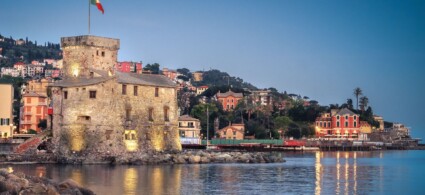
The Ligurian coast is dotted with structures built for defence or lookout purposes. Lavagna has its own: the Torre del Borgo, constructed in the 16th century, probably at the behest of the noble local Fieschi family.
After serving for centuries as a defensive structure, the tower was later used as a stately residence and today houses a museum; inside are an art gallery dedicated to slate and the Alloiso collection.
The garden facing the tower frequently hosts exhibitions, concerts and other outdoor events.
The Collegiate Basilica of Santo Stefano is considered Lavagna’s most beautiful church and one of its oldest: the current baroque façade dates from the 17th century, but the original structure goes back to the 10th century.
Entry to the church is via a monumental staircase. The three-aisled interior is richly decorated and contains several works by Domenico Piola, one of the leading exponents of Genoese baroque.
Behind the church stands a monumental cemetery considered one of Liguria’s most important.
One side of the square where the Basilica of Santo Stefano stands is dominated by the elegant Brignardello Arcade, built in the late 19th century.
This structure allows passage from the square to the cemetery without using the church’s staircase and provides an elegant setting for numerous town events, including the historical re-enactment of the Torta di Fieschi.
One of Lavagna’s finest civic buildings is Palazzo Franzoni: constructed in the late 18th century, over the centuries it was home to the Marchesi Franzoni, Napoleon Bonaparte and Lazzaro Repetto, a local farmer who made his fortune in Argentina.
It served as a stately residence, hospital and hotel; today it houses the Town Hall.
The Entella is a stream formed by the confluence of three watercourses in the municipality of Carasco, about 8 km from Lavagna: the Lavagna stream, the Graveglia and the Sturla.
Where it flows into the sea, the Entella marks the boundary between Lavagna and Chiavari: this wetland provides a natural habitat for many waterbirds including gulls, swans, mallards, coots, cormorants and grey herons.
Both banks of the Entella can be walked or cycled along a cycle and pedestrian path equipped with benches and viewing areas, perfect for stretching your legs or reading a book in the fresh air. Since 1988, this area has been designated a protected wildlife sanctuary.
A good vantage point for observing the sanctuary is the small Ponte della Maddalena, which connects Lavagna and Chiavari. Originally built in the Middle Ages as a wooden bridge, it was later replaced with a stone bridge featuring thirteen arches, and in 2010 was restored and fitted with new lighting.
It’s not a famous bridge and can’t even be called an architectural marvel, but for locals it represents an important piece of their local heritage.
In the following map you can see the location of the main places of interest mentioned in this article.
Lavagna is a convenient base for exploring the Riviera di Levante: picturesque spots like Portofino and Camogli are just 25 km away; the unmissable Cinque Terre are 50 km distant, and if you want to stop closer by, you can visit Levanto. Genova is also easily accessible as a day trip.
Nature lovers and outdoor enthusiasts will find three natural parks to explore on foot or by bike not far from Lavagna: the Cinque Terre National Park, Portofino Regional Park and Aveto Regional Park.
Lavagna is a very popular holiday destination with boat owners, and whilst it’s well-known, it offers a smaller selection of tourist accommodation compared to the nearby town of Chiavari.
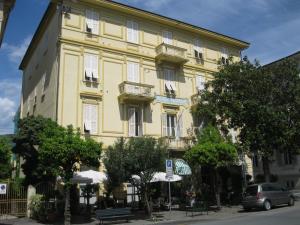
You can nonetheless find a good choice of hotels, apartments and holiday homes, many housed in attractive townhouses with pastel-coloured walls. Hotels are mostly mid-range: if you’re looking for something luxury for a special occasion, head to Chiavari or other nearby towns.
Lavagna’s best hotels and apartments are located on the seafront, conveniently close to both the beach and the historic centre.
We offer a selection of hotels at Lavagna to suit all categories of travellers. The most booked by tourists are the sea-facing hotels, often right on the beach. If you want to play it safe, choose one of the following: they are among the most booked hotels in Lavagna, sorted by number of reviews.


If you prefer space, privacy and the ability to prepare your own meals to a hotel holiday, book a holiday home at Lavagna. We recommend a few below, but in this case we advise you to book early because houses and apartments for rent at Lavagna are in high demand.


Reaching Lavagna by car is straightforward: simply take the A12 motorway Genova-Livorno, exit at Lavagna and follow the signs for the town centre.
Those travelling by public transport will have no difficulty reaching Lavagna either. The railway station in the town centre is located on the Genova-La Spezia line, served by frequent regional and Intercity trains. There’s also a station in the Cavi hamlet, served only by regional trains.
The closest airport is Genova, connected to numerous Italian cities by budget flights.
What's the weather at Lavagna? Below are the temperatures and the weather forecast at Lavagna for the next few days.
Lavagna is a town in eastern Liguria. Administratively, it falls within the territory of the Metropolitan City of Genoa and sits roughly halfway between the Ligurian regional capital (45 km to the west) and the city of La Spezia (60 km to the east).
 Hotel
Hotel  Budget accommodations
  Apartments
  Family Hotel
 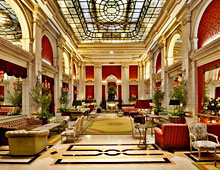 Luxury Hotel
 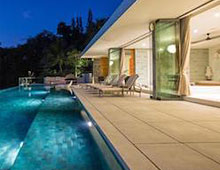 Resorts