Hotel Santa Maria
Chiavari - Viale Tito Groppo 29
Enjoy the comfort, the sea views and the friendly service at this 3-star hotel set on the seaside promenade of Chiavari, home of beautiful blue-flag beaches.
Book now
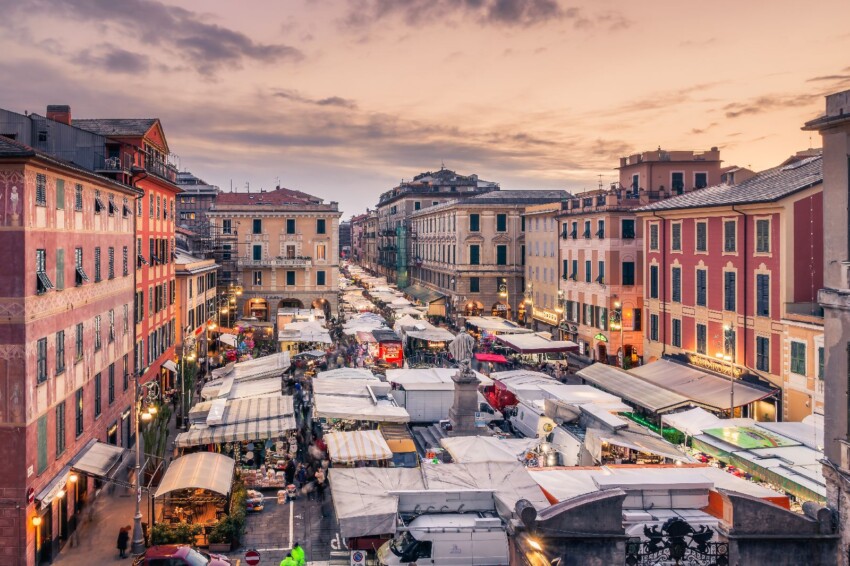
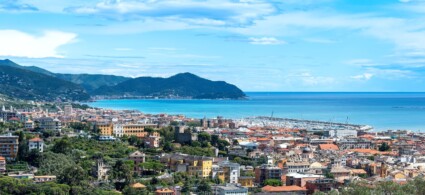
Chiavari is the nerve centre of the Tigullio: the main commercial, residential and financial hub, it is also one of Liguria’s most important tourist ports.
A city with ancient maritime traditions, it still reveals in many ways its economy strongly tied to the sea: shipyards, boat storage facilities, artisan workshops specialising in woodworking and fibreglass, embarkation points for tourist cruises.
Its most famous attractions are the marina and the seafront promenade, but Chiavari isn’t your typical seaside resort that only comes alive in summer months. Rather, it’s a dynamic, bustling city that’s mercifully still human in scale: perhaps thanks to its charming medieval-style historic centre, with arcaded streets and splendid 19th-century palaces, helped along by the mild climate of the Riviera.
A great variety of landscapes awaits visitors: the coastline where some of the most famous beaches of the Tigullio can be found, the arcaded streets and little squares of the centre, and the hills and valleys of the Chiavari hinterland. The nightlife is very lively but free from excess or transgression; daytime entertainment suits all ages.
Easy to reach by car or train, conveniently close to other stunning tourist destinations, Ciävai (as Chiavari is known in the local dialect) is perfect as a base for a wonderful holiday in Liguria in every season of the year.
Chiavari’s attractions are scattered between the historic centre, the seafront and the hinterland. Here are the most interesting things to see.
Carruggi are the typical medieval arcaded streets that characterise Borgolungo, Chiavari’s centre. The combination of Via Martiri della Liberazione and Via Vittorio Veneto makes up the so-called Carruggio Dritto, the thoroughfare that cuts lengthways through the historic centre and represents the pulsing heart of city life.
Lined with cafés and shops, it’s a lively place, always bustling with people of all ages, perfect for a pleasant urban stroll, shopping or stopping for a coffee at an outdoor table.
The historic cafés will serve you a bracing espresso accompanied by the typical Sorrisi di Chiavari, liqueur-filled chocolates.
Hidden in the shade of the arcades are numerous artisan workshops that Chiavari is rightly proud of. Testimonies to ancient traditions still thriving today, these workshops have a romantic charm of bygone times and are worthy attractions: spend the time they deserve.
The most famous artisan workshops are those producing chiavarine, super-lightweight yet sturdy wooden chairs, although production has since moved out of the centre.
In the Carruggio Dritto and its surroundings you can have fun browsing a jeweller’s with removable counters on rails, a wine bar with elegant wooden furnishings, a candle shop selling handmade candles. Be amazed by a woodcarver passing down the art of hand-carved ship figureheads. Step into a tripe shop to discover how much skill goes into making perfect tripe.
After all this browsing you’re bound to be hungry: stop at a trattoria to enjoy a plate of hot farinata, trofie with pesto or another local speciality.
Fully integrated into the urban setting, Chiavari’s tourist port is the other nerve centre of Chiavari’s social and economic activities. Following the creation of the port in the Seventies, tourism developed here, later than in other Ligurian locations.
For boat owners, Chiavari’s port is one of Italy’s best marinas: quality services and its location just a few miles from enchanting destinations like Portofino and Cinque Terre make it one of the most frequented ports not only in Liguria but also in Tuscany, Sardinia, Corsica and the French Riviera. It can accommodate over 500 vessels, plus an additional 150 berths at Calata Ovest.
For tourists without a boat it’s another place besides the Carruggio Dritto to walk or people-watch, this time with the sound of the waves as a soundtrack.
The promenade connecting the seafront to the tourist port area extends for about 2 km along Corso Valparaiso: it’s lined with bars, restaurants, ice cream parlours, pizzerias, fountains, green spaces and children’s play areas.
At one end of the avenue is the charming Piazzetta dei Pescatori, an excellent spot for watching the sunset over the Riviera.
The city of Chiavari can boast one of the oldest castles in the Tigullio area: it’s a defensive structure built in the first half of the 12th century.
Today only the main tower with its two water cisterns, a fortified parade ground and part of the defensive walls remain of Chiavari Castle. Though privately owned and not open to the public, it’s considered a civic symbol.
One of the best-known squares in Chiavari’s centre is Piazza Nostra Signora dell’Orto, dominated by the cathedral of the same name which is the episcopal seat and Marian sanctuary. The procession for the patron saint’s festival, held in July, starts from here.
The Sanctuary of Our Lady of the Orchard is an elegant church built in the early 17th century to commemorate a Marian apparition that occurred to local citizen Sebastiano Descalzo; it was erected in an area once covered with vegetable gardens, hence the name.
In the 19th and 20th centuries it underwent major modifications including the addition of a marble colonnade that made it resemble the Pantheon in Rome; the current façade dates from 1938. Inside it houses valuable paintings and sculptures.
On the same square stands Palazzo Bianco, another elegant neoclassical building that now houses the town hall.
Villa Rocca Botanical Park is an oasis of greenery right in the centre, characterised by breathtaking views over the city and sea: laid out on different levels, it’s an ideal place to enjoy the views in complete relaxation.
The garden was designed in the early 20th century by Genoese architect Polinice Caccia on commission from the Rocca family, who had returned from Argentina wanting to recreate an environment reminiscent of different parts of the world.
Lose yourself among its geometry that combines perfection and harmony as you search for pavilions, grottoes, small lakes, waterfalls, little temples and irregular flower beds that follow the slope of the terrain, adorned with mimosas, palms, European conifers and exotic plants from subtropical areas. A monumental staircase links the original core of the garden to a later extension.
Two other churches linked to Marian worship are the Sanctuary of Our Lady of Grace6 and the Sanctuary of Our Lady of the Olive Tree7. The former, visible from the sea, is particularly striking.
Another church worth noting is St John the Baptist8, in the square of the same name: built in 1181, it was completely rebuilt in the 17th century.
During your urban walk, pay attention to the splendid civic buildings too: the oldest is the Palazzo dei Portici Neri, dating from the 12th century and located immediately below the castle. Among the finest also worthy of mention are Palazzo Franzone from the 16th century and Palazzo Gagliardo (formerly De Scalzi) from the 18th century.
A holiday in Chiavari isn’t just about lounging on the beach and strolling through town: the city offers many opportunities for outdoor sports and activities.
Hiking and cycling enthusiasts can leave behind the constant murmur of the coast and climb to higher ground in search of some peace in the splendid landscapes of the hills. There are numerous trekking and mountain bike trails that venture into the fascinating Chiavari hinterland, ranging from easy well-marked routes to more challenging paths reserved for experts only, but all characterised by the unique sea-to-land blend that makes Liguria special.
The Ciclovia dell’Ardesia also passes near Chiavari, a 35 km cycling route that winds through the valley parallel to the Entella river, crossing villages and natural areas. Some sections are suitable for everyone, including families with children, while others are recommended only for experienced cyclists.
Thanks to its position, roughly halfway along the Gulf of Tigullio, Chiavari is an excellent base for exploring the most famous attractions of the Riviera di Levante.
In about half an hour by car you can reach Portofino, Camogli, Rapallo and Santa Margherita Ligure; from these locations you can reach the striking Abbey of San Fruttuoso by boat. It takes longer to reach Cinque Terre but it’s still doable as a stress-free day trip (allow about an hour and a half).
In the following map you can see the location of the main places of interest mentioned in this article.
Chiavari’s shoreline is a succession of fine sand and shingle beaches washed by the typical clear azure sea of Liguria, clean and rich in marine life.
The beaches in town stretch almost entirely west of the tourist port and are easily accessible on foot from the seafront promenade and the centre; venturing beyond the built-up area there’s a naturist beach, and further still a wild-looking beach accessible only by sea.
There’s good news for those who don’t like having to pay to sunbathe: Chiavari, along with Sestri Levante, has the highest percentage of free beaches in the Tigullio Gulf.
Don’t worry if you prefer the convenience of a beach resort instead, with umbrellas, loungers and all services at hand: there are more than five along the town’s shoreline and they include beaches accessible for disabled visitors and dog-friendly beaches for those travelling with a four-legged friend. Services are of excellent quality, and indeed Chiavari’s beaches have won the Blue Flag award on several occasions.
A barrier of rocks protects the bathing area, which is why the sea here is always calm: small children and inexperienced swimmers can bathe safely in Chiavari’s clear waters!
The most family-friendly beach is the one near the station, equipped with an aqua park featuring 18 inflatables.
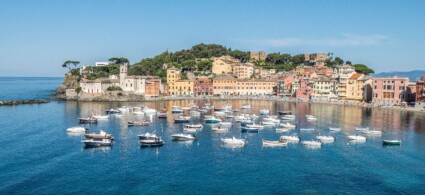
If you want a change of atmosphere, head to the splendid nearby beaches: don’t miss Baia dei Paraggi, Baia del Silenzio, Baia delle Favole and Baia di San Fruttuoso.
Chiavari is a very popular tourist destination with a wide choice of hotels and bed & breakfasts for all budgets.
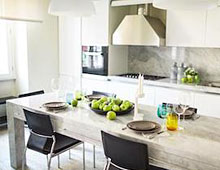
You can find budget accommodation without leaving the centre, particularly near the tourist port: these are no-frills b&bs and hotels, but clean and functional. If you’re willing to spend more, you can choose from elegant hotels housed in historic palaces, villas with gardens, bright apartments with every comfort and even modern industrial-style lofts.
Hotels and apartments near the beach are the most sought-after, but don’t overlook accommodation in the hinterland: you’ll gain in peace and quiet and might find rooms with magnificent panoramic views at reasonable prices.
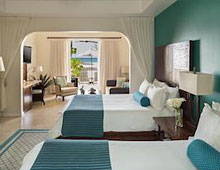
We offer a selection of hotels at Chiavari to suit all categories of travellers. The most booked by tourists are the sea-facing hotels, often right on the beach. If you want to play it safe, choose one of the following: they are among the most booked hotels in Chiavari, sorted by number of reviews.


If you prefer space, privacy and the ability to prepare your own meals to a hotel holiday, book a holiday home at Chiavari. We recommend a few below, but in this case we advise you to book early because houses and apartments for rent at Chiavari are in high demand.


Getting to Chiavari by car is straightforward: simply take the A12 motorway (towards Genoa if coming from the south or east, towards Sestri Levante/Livorno if coming from the west) and exit at the Chiavari junction.
Arriving by train is also easy as the city has a railway station served by numerous regional and Intercity trains. Regional bus services are also available linking Chiavari with the main towns in Liguria and northern Tuscany.
The nearest airport is Genoa’s.
What's the weather at Chiavari? Below are the temperatures and the weather forecast at Chiavari for the next few days.
Chiavari is located in the Gulf of Tigullio (Riviera di Levante) approximately 35 km from Genoa and about 70 km from La Spezia.
 Hotel
Hotel 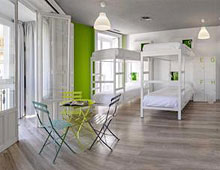 Budget accommodations
  Apartments
  Family Hotel
  Luxury Hotel
  Resorts